
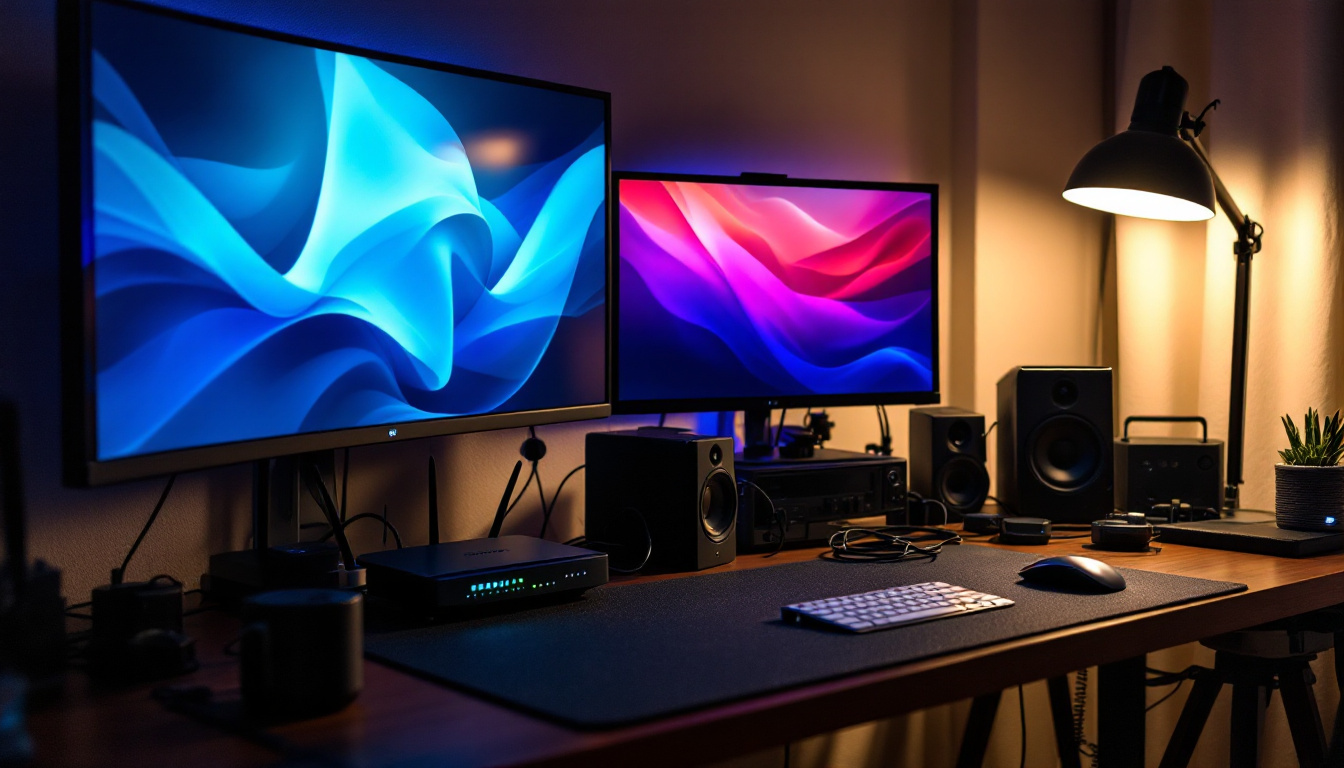

A device-dense office and a device-dense apartment can produce very different experiences, even when the raw number of wireless sources is similar. For a catalog of what people commonly report noticing, see Common Patterns People Notice in Tech-Heavy Environments. This is a different question: why does the same person often notice more in one type of space than another?
The Home Office
Long, uninterrupted hours in one spot, usually with a router, a laptop, a phone, and often extra monitors all within a few feet. The exposure is high relative to other rooms in the house, though still typically within the limits set by international bodies like ICNIRP, and it is also the one setting most people actually control. You can move the router, change the desk position, or step out for a break whenever you want.
The Dense Apartment or Building
Here the variable is not just your own devices. It is everyone else’s too. Shared walls mean neighboring Wi-Fi networks, smart home equipment, and sometimes building-wide wireless infrastructure all overlap in a way a detached house does not, as covered in Can Living In An Apartment Increase EMF Exposure? The practical difference: you cannot simply turn off what is not yours.
Public and Semi-Public Spaces
Coffee shops, coworking spaces, waiting rooms. The device density can be just as high as a home office, but the exposure window is usually shorter and you have essentially no control over the environment. That combination makes it a poor place to run any kind of personal experiment, even if it is where some people notice the most.
Travel and Hotels
Part of why people report feeling better when they leave home or sleeping better in some places than others may simply come down to an unfamiliar room with fewer personal devices in it, not any single factor in isolation.
Why the Setting Matters as Much as the Symptom
Matching your investigation to the type of space you are in makes the difference between a useful experiment and a frustrating one. A home office is where you can change one variable and observe. A coworking space or a friend’s apartment is not, and trying to run a controlled test there usually just produces noise. In spaces you do not control, the most useful thing is simply noticing how you feel there compared with elsewhere, and saving the actual experimenting for the environment you can change.
Frequently Asked Questions
The lived experience is real. What the cause is remains less certain. People are not inventing discomfort. What is less clear is which factors in the environment are most responsible.
In many cases, yes. Sedentary work without breaks produces real physical discomfort. But some people report observations that persist even when they are moving and taking breaks, which suggests something else may also be a factor.
Individual variation in sensitivity to environmental factors is well established across many domains. Some people are more affected by noise, light, or temperature than others. It would not be surprising if something similar applies to electromagnetic environments. A peer-reviewed review of the scientific evidence on individual electromagnetic sensitivity found the picture is still genuinely mixed.
Start by noting them specifically: when they occur, what the environment is like, and what changes when they resolve. A few weeks of careful observation is more valuable than any number of general recommendations.